
This article can be interesting for CIAs who earned thier titles based on former syllabi so as to be able to give information current candidates in case of any questions arises.
Why the CIA Exam Changed in 2025?
The Institute of Internal Auditors (IIA) revamped the CIA exam to:
· Reflect modern global internal audit practices
· Align with the new Global Internal Audit Standards™ (effective January 9, 2025)
· Reduce redundancy across the three exam parts
· Clarify required knowledge and skills for candidates
The 2025 CIA exam update isn’t just a refresh based on new Global Audit Standards —it’s a redefinition.
Transition Rules You Should Know
Rule 1: English exam transitions was on May 28, 2025. Other languages follow a staggered schedule (e.g., Japanese: July 28, Spanish: October 28, etc.)
Rule 2: Passed parts under the old syllabus remain valid for 3 years from registration. If you passed any part before the new syllabus launches, you don’t need to retake it under the new format—unless your program expires. You can mix new parts with formerly passed parts (e.g., Part 1 & 2 before May 28, 2025 + Part 3 after) and still earn the CIA designation. Several other combinations are possible if we consider the languages as well. But to buy new learning materials is highly recommended
No Prescribed Order: You can take the parts in any order. The IIA doesn’t require a specific sequence.
Part 1: Internal Audit Fundamentals
The name of Exam Part 1 was changed from "Essentials of Internal Auditing" to "Internal Audit Fundamentals". There were moderate adjustments, mainly refining foundational concepts. It can be said that Part 1 has changed the least in the entire CIA exam system; in other words, it has the most in common with the old syllabus.
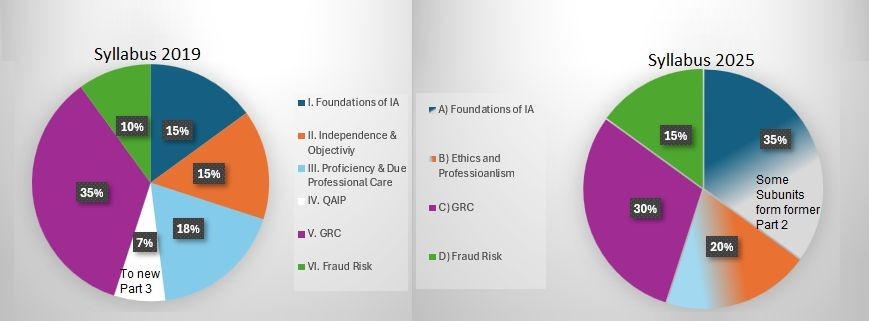
Foundations
Syllabus 2019 | Syllabus 2025 |
I. Foundations of Internal Auditing 15 % | A) Foundations of Internal Auditing 35 % |
The weight of this unit has apparently increased significantly; however, this does not necessarily mean that the fundamentals will be scrutinized much more deeply. Rather, it is a consolidation of core Standard components based on the new system. Crucially, quite a few subunits from the former Part 2 (such as the types of Assurance and Advisory Services) have been moved here. This consolidation is visually indicated by the blue-to-gray color transition in the pie chart, showing that the section is composed of more than just its original content.
Independence, ethics, professionalism
Syllabus 2019 | Syllabus 2025 |
II. Independence & Objectivity 15 % | B) Ethics & Professionalism 20 % |
III. Proficiency & Due Professional Care 18% |
Two main units, which were closely related anyway, were merged into one. Overall, their combined weight decreased from 33% to 20%. This reduction does not mean that the importance of these units has diminished. These principles will also arise later in several other practical issues in Part 2 and Part 3.
QAIP moved to Part 3
Syllabus 2019 | Syllabus 2025 |
IV. Quality Assurance and Improvement Program | Moved to Part 3 |
This unit was entirely moved to Part 3 (Internal Audit Function). This strategic shift highlights that the overall management and governance of the internal audit function, including QAIP, is now considered a strategic, leadership-level responsibility, appropriate for the redefined Part 3 syllabus.
GRC and Fraud Risk
Syllabus 2019 | Syllabus 2025 |
V. Governance, Risk Management, Control 35 % | C) Governance, Risk Management, Control 30 % |
VI. Fraud Risk 10 % | D) Fraud Risk 15 % |
There were no significant thematic changes to GRC, just a minor adjustment in weight. Conversely, the weight assigned to Fraud Risk increased, indicating a growing emphasis on understanding the basic principles of fraud schemes and detection even at the foundational level of the CIA exam.
Part 2: Internal Audit Engagement
The name of Exam Part 2 was changed from „Practice of Internal Auditing” to „Internal Audit Engagement”. While this content underwent significant restructuring—arguably more so than Part 1, but certainly less than Part 3 — this overhaul is visually summarized in the figure below.
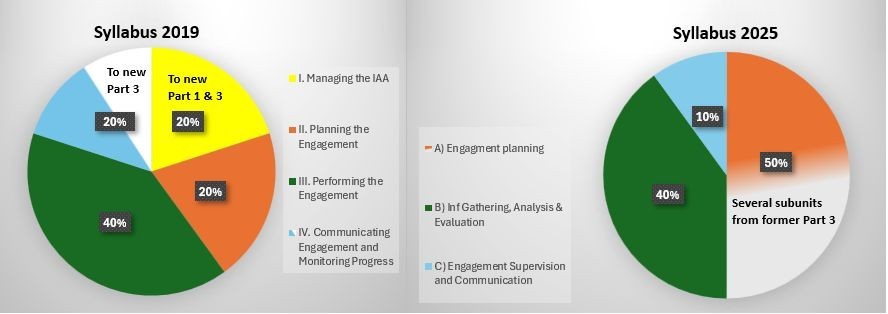
Managing the IAA moved to Part 1 & 3.
Syllabus 2019 | Syllabus 2025 |
I. Managing the Internal Audit Activity 20 % | Moved to Part 1 |
Moved to Part 3 and split into two units |
This unit was eliminated from Part 2, but Its content was redistributed across the other two exam parts:
· New Part 1: As we discussed in the previous article concerning Part 1 changes, several subunits from the former Part 2 (such as the types of Assurance and Advisory Services) have been relocated to Part 1.
· New Part 3: Other subunits from this eliminated unit were moved to Part 3, which itself was subsequently split into two distinct Units. We will provide a detailed analysis of these specific changes in the article dedicated to Part 3 revisions.
Planning
Syllabus 2019 | Syllabus 2025 |
II. Planning the Engagement 20 % | A) Engagment Planning 50 % |
Frequently, the professional community debated whether the elimination of the former Part 3, "Business Knowledge for Internal Auditing," which was widely considered the most difficult of the three parts, would lead to an excessively simplified path to achieving the Certified Internal Auditor (CIA) designation. A closer examination of the curriculum, moving beyond the mere unit and subunit titles, reveals that this assumption is inaccurate. In addition, the unit's weighting dramatically increased from 20% to a substantial 50%.
While the former content of Engagement Planning has largely remained consistent, the dramatic increase in weighting is due to the integration of several critical subunits (Basic Acumen as well as IT related units) migrated from the former Part 3 (Business Knowledge for Internal Auditing).
What is the fundamental conclusion we can draw from this restructuring? The former Part 3 material was arguably somewhat disjointed or isolated within the curriculum. Now, some of the previous Part 3 units have been directly linked to the practical components of the exam. While the weighting of these specific units may appear reduced as they are now embedded within other exam parts, the overall workload and complexity for the candidates have certainly not decreased.
Performing
Syllabus 2019 | Syllabus 2025 |
III. Performing the Engagement 40 % | B) Information Gathering, Analysis and Evaluation 40 % |
The weight of this section remained constant at 40%. Although the subunit has been renamed, its content has not changed significantly. Consequently, most study materials are expected to feature very similar chapters on this unit.
Communication and Monitoring – stayed and/or moved to Part 3
Syllabus 2019 | Syllabus 2025 |
IV. Communicating Engagement and Monitoring Progress 20 % | C) Engagement Supervision & Communication 10 % |
Moved to Part 3 |
The content of the former Part 2 subunit was effectively split into two components:
· New Part 2: Some core elements were retained in the new Part 2 syllabus under unit C.
· New Part 3: Most of the key elements, particularly those related to Recommendations and Monitoring, have been relocated to the new Part 3 exam Unit D.
This split unit now accounts for 10% of the new Part 2 exam, while the relocated elements constitute 45% of the new Part 3 exam. This combined weighting significantly surpasses the former Part 2's weighting for these activities (which was 20 %), ultimately indicating an overall increased importance placed on the Value Added Activity of Internal Auditing.
Part 3: Functions of Internal Auditing
The new Part 3 is almost entirely different from its predecessor. The former Part 3 was entitled "Business Knowledge for Internal Auditing". The new Part 3 fundamentally represents a consolidation of the former Part 1 and Part 2 Units that focused specifically on the management activities of the Chief Audit Executive (CAE). By aggregating these key leadership responsibilities into a dedicated exam part, the unit of Internal Audit Management now receives significantly greater attention and weighting compared to previous syllabi.
The summary of these massive changes is illustrated in the figure below, which clearly reflects the scale of this restructuring.
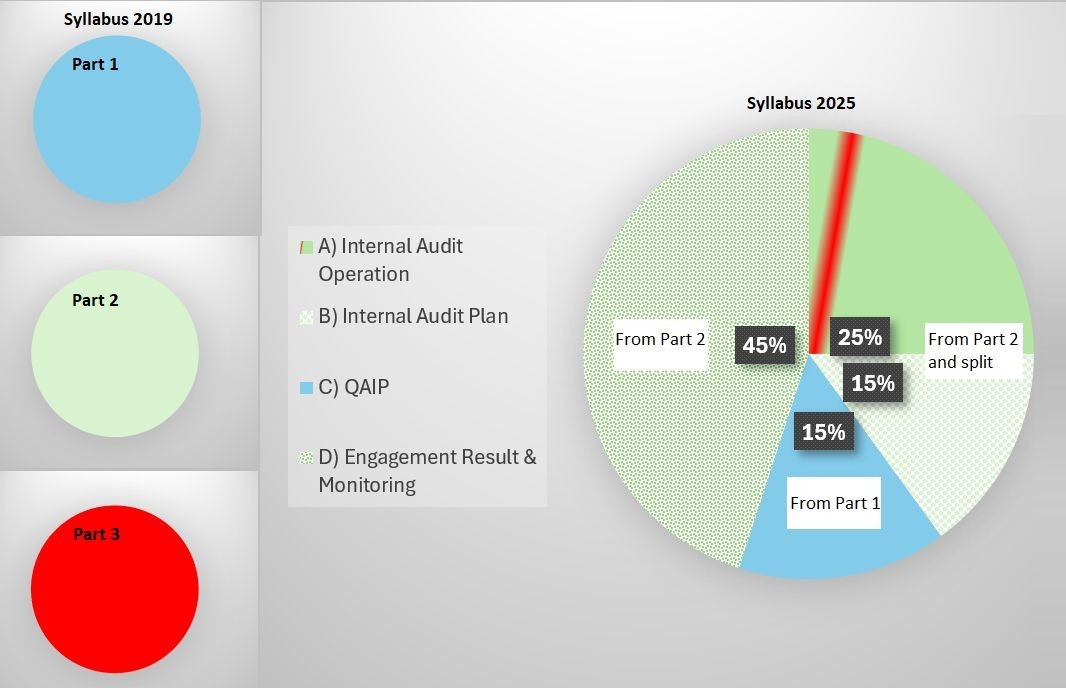
The Fate of Former Part 3 Units
Syllabus 2019 | Syllabus 2025 |
I. Business Acumen 35 % | Partially moved to Part 2 Small subunits stayed in Part 3 Partially eliminated |
II. Information security 25 % | |
III. Information Technology 20 % | |
IV. Financial Management 20 % |
Its four main units have not been totally eliminated from the CIA exams, but have been strategically relocated:
· Several units and subunits moved to the new Part 2 A) Engagement Planning, as discussed.
· Some smaller subunits retained in the new Part 3 A) Internal Audit Operations (specifically within Resource management).
· Certain highly specialized areas (Managerial accounting concepts, Costing systems, and specific IT infrastructure concepts) are no longer directly included in the exam syllabus.
Relocation of IAA Management from Part 2
Syllabus 2019 | Syllabus 2025 |
From Part 2 I. Managing the IAA | A) Internal Audit Operations 25% |
B) Internal Audit Plan 15 % |
2019 Part 2 I. Managing the Internal Audit Activity VS 2025 Part 3 A) Internal Audit Operation & B) Internal Audit Plan
The former Part 2 Unit was not only moved to the New Part 3 (and Part 1), but was also split into two distinct Units. Collectively, the relocated elements received a greater weighting: increasing from 20% up to 40%. Furthermore, considering some subunits moved to Part 1, the total focus increase on these management units is substantial.
QAIP from Part 1
Syllabus 2019 | Syllabus 2025 |
From Part I. QAIP | C) QAIP 15 % |
The weighting of Quality Assurance and Improvement Program (QAIP) has also increased. It was 7% in the former Part 1, but is now weighted at 15% in the new Part 3 syllabus.
Emphasis on Value-Added Outcomes from Part 2
Syllabus 2019 | Syllabus 2025 |
Form Part 2 | D) Engagement Results & Monitoring 45 % |
As noted, roughly half of this former Part 2 unit was retained in the new Part 2 (at 10%), while the other half was relocated to Part 3. The total weighting of this split section significantly increased from 20% up to 55% (10% in Part 2 and 45% in Part 3). This huge increase indicates that internal auditing must deliver tangible results to add Value to the Organization.
The changes and transitions can be summarized in the following charts:
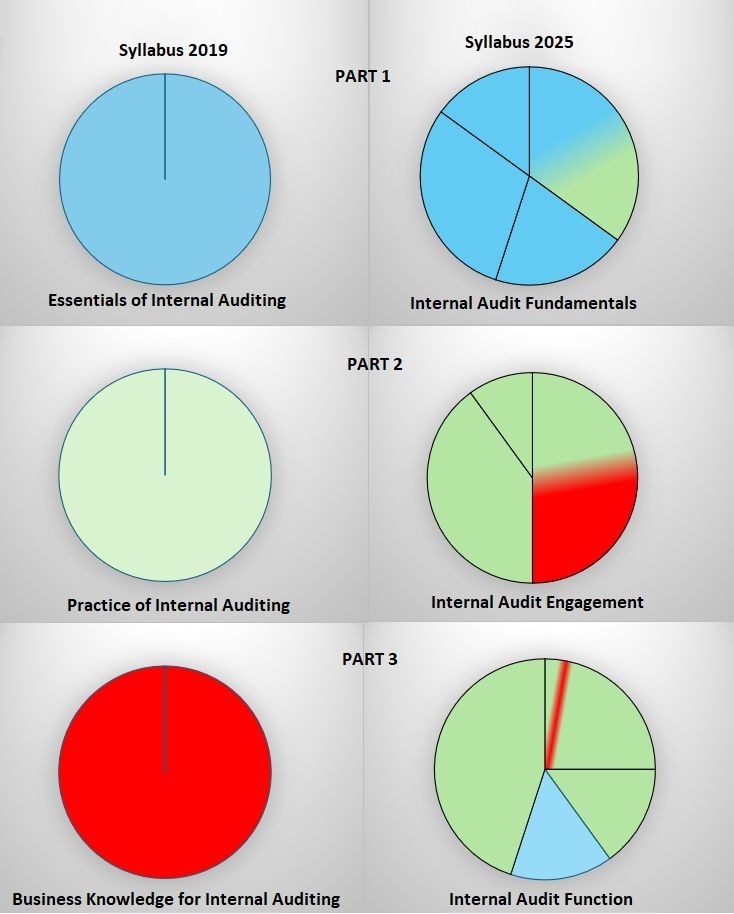
Conclusion
The overall structure clearly indicates that the CIA program has been strategically reorganized to follow the real-life audit flow: Fundamentals (Part 1) lead to Planning and Execution (Part 2), which culminates in Management and Value-Added Outcomes (Part 3). The result is a more integrated and practically relevant certification designed to prepare auditors for leadership roles.
Is the new system easier or harder for candidates? Which is the hardest Part, and which is the easiest part of the new system. There is no universal answer this question. It depends on each candidates interest and experience.
Sources:
2019 CIA Syllabi
2025 CIA Syllabi
https://www.theiia.org/en/certifications/cia/exam-prep-resources/exam-syllabus/
Gleim CIA products
https://www.gleim.com/cia-review/
Zain Academy CIA products
https://zainacademy.us/product-category/cia-exam-review/
Charts are created by EXCEL and Paint